
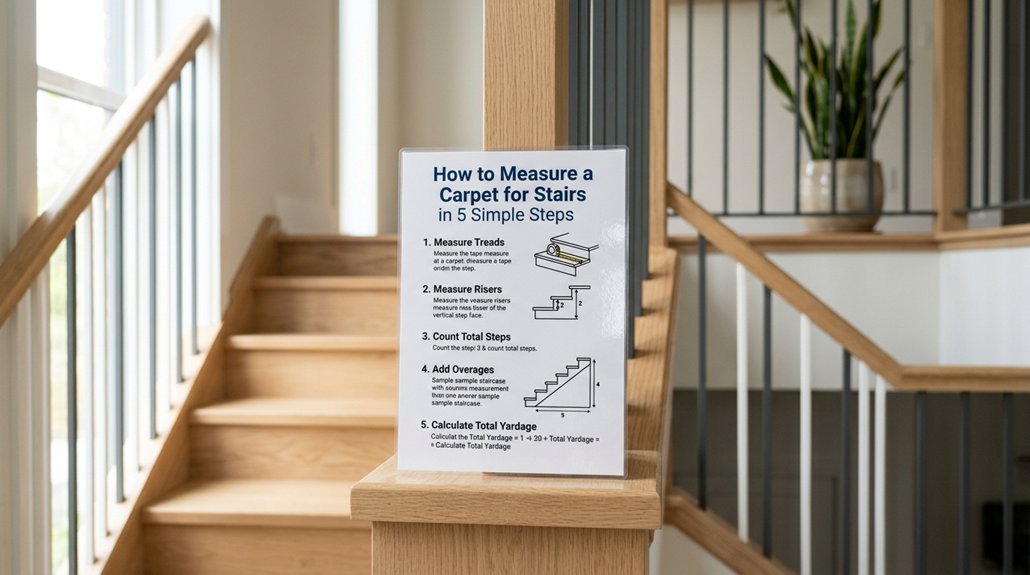


You might think measuring stairs for carpet requires a professional, but you’ll handle this yourself with a tape measure, notepad, and five straightforward steps that account for pile direction, which is the orientation of carpet fibers that must run consistently from landing to stairs for uniform appearance. You’ll start by treating your landing and top step as one continuous surface, recording length, width, doorways, and alcoves while ensuring the pile flows downward. Then you’ll capture tread depth, riser height, and width for straight stairs, adding 5 cm for underlay compression and precise trimming. Winders and curves demand individual attention with 10 cm allowances for their widest points. Your calculations will sum each stair’s run multiplied by width, plus landing areas, before you apply 5–10% waste factors. The difference between a seamless installation and costly errors lies in what most guides overlook about directional consistency and compression tolerances.
Measure Your Landing and Top Step First
Where should you begin when measuring carpet for stairs? You’ll start with the landing and top step, creating a plan that transition your carpet flows seamlessly from room to stairs.
First, you’ll measure the landing as you would a room, recording its length and width in one continuous plan that captures doorways, alcoves, and ensure to adjacent flooring. Include the top step riser in your landing measurements, extending your continuous measurement over the top nose area. This maintains consistent pile direction where the landing meets the stairs.
Sketch your layout on paper, marking the top step location and its relationship to doorways and surrounding spaces. By treating the landing and top step as interconnected zones requiring precise measurements, you’ll establish the foundation for accurate carpet ordering that eliminates seams and transition professional results across your entire staircase project.
Recommended Products

13 ft. Of reach*: allows for easy measurements when working alone (*based on maximum extension of average professional user)

Tape measure with MID accuracy and both inch and metric scales; measures up to 16 feet (5 meters)

▁▃▅▇【Reusable Material】These stair tools are engineered from impact and chemical resistant iron Material, which are very durable and reusable. Very easy to adjust the angle and length to match any job requirement.
Measure Tread, Riser, and Width of Straight Stairs
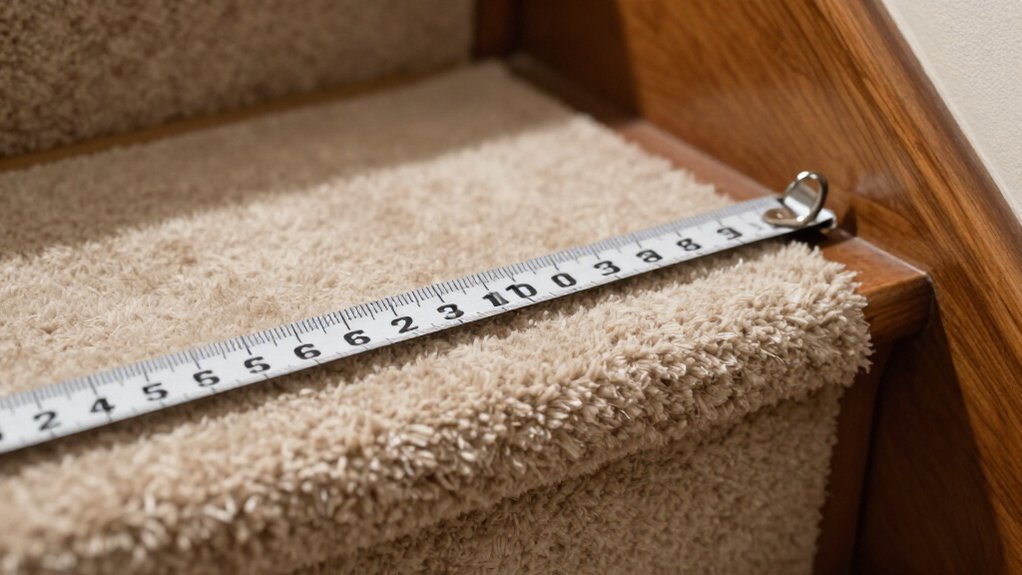
With your landing and top step measurements documented, you’ll move on to the stair run itself, where precise calculations for each tread, riser, and width determine how much carpet you’ll actually need. For straight stairs, you’ll measure the tread depth from back edge to front edge and the riser height from the top of one tread to the top of the next. Add 5 cm, approximately 2 inches, to both dimensions for your underlay allowance and trimming needs. Multiply this per-step length by your stair count to calculate total run length. For stair width measurement, measure the width of one step edge to edge, adding another 5 cm for fitting. Record all measurements consistently on your measuring plan, noting any variations you encounter.
Recommended Products

Non-Slip Landing Rugs: Our stair landing rugs feature a proprietary TPE non-slip backing that keeps the landing mats firmly fixed to your stairs landing without shifting or slipping, better protecting your loved ones. Perfect for homes with kids, seniors, or pets (dogs or cats)

【Non-Slip & Safe】:The runners for hallways with rubber backing are coated with a TPR backing to help the non slip runner rug stay in place. Sufficient grip to prevent dangerous slips for the elderly and children. Non-slip runner also protect laminate and hardwood floors
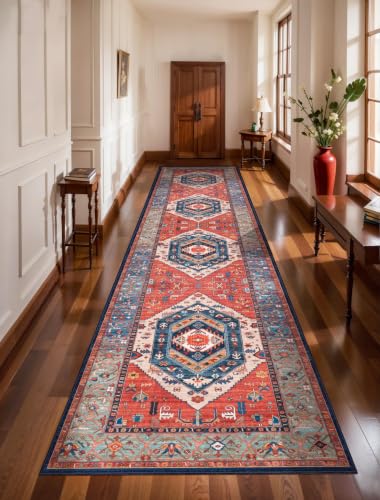
❤️【Soft Low Pile Rug】 This area rug is made of high-quality polyester. Ultra pleasant soft feel and quality appearance. The rug is low pile but it is very soft, almost plush feeling. The texture is very bare-feet friendly and is luxury soft underfoot.
Measure Winders, Turns, and Curved Stairs
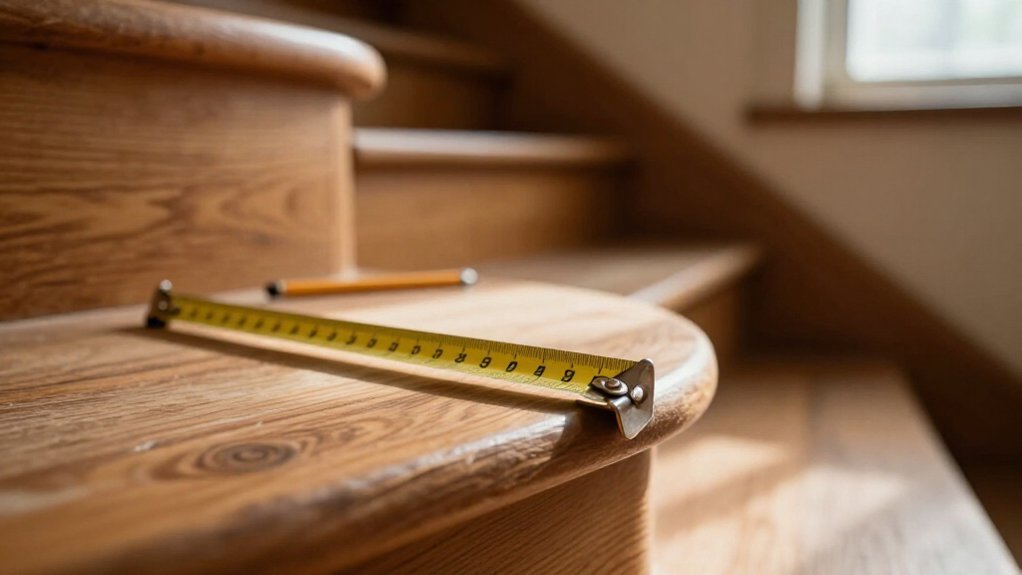
Although straight stairs follow a predictable pattern, winders, turns, and curved stairs demand a more meticulous approach because each angled or radiating step varies in width and shape, requiring you to measure every winder individually at its widest point, typically the outer edge where your foot lands most frequently, to capture the full running area your carpet must cover. Record each of the winder widths separately, as these measurements directly impact your carpet measurement and total material requirements. Include the stair landing’s top riser where winders terminate, ensuring consistent pile direction across all sections. Treat winders as distinct components in your stair plan, adding trimming allowances for precise curved cuts. Maintain ply alignment between winders, straight flights, and landing areas for seamless visual continuity.
Recommended Products

Solid Brass construction: These carpet holder clips are crafted from solid Brass with a PVD finish that resists tarnishing and corrosion, maintaining a polished appearance with minimal upkeep.

👏NICE SOLUTION FOR ANTI-SLIP-- RIOLAND indoor carpet stair treads use non-slip material on the backing, so they can stay in place firmly even under high traffic, and provide great grip and traction to guard little babies, elders, and cute dogs from slipping on floors.

👏WISE SOLUTION FOR ANTI SLIPPING & ANTI MOVING-- Rioland stair treads select non-slip material at the bottom, they can firmly adhere to your stairs and keep in place. Provide extra ground friction so that your family and pets' safety can be secured well when they go up and downstairs.
Calculate Total Carpet Area Needed
Every single stair in your home, whether it is a standard straight step, a winding winder, or a broad landing platform, contributes its own distinct footprint to the total carpet area you will need to purchase, so you must methodically add each component’s dimensions rather than guessing or rounding up blindly. In this calculation step, you multiply each stair’s run length by its stair width to find that stair’s carpet area, then sum these across all straight stairs. You then add your landings, measuring each length and width as one continuous piece with the stairs, and include any winders or alcoves from your stair measurements as separate additions. Finally, you apply a 5–10% waste factor to this total area, which covers trimming, pattern matching, and fitting errors so your final carpet area proves sufficient for complete, professional installation.
Recommended Products

Premium Polyester Carpet Treads: Crafted from 100% PureColor Soft Solution Dyed BCF Polyester, these treads feature a classic, soft design to enhance the warmth of your home.

👏WISE SOLUTION FOR ANTI SLIPPING & ANTI MOVING-- Rioland stair treads select non-slip material at the bottom, they can firmly adhere to your stairs and keep in place. Provide extra ground friction so that your family and pets' safety can be secured well when they go up and downstairs.

Cut to Size Stair Treads: Our Cuttable Carpet Stair Treads measure 30 x 8 inches, allowing you to easily cut them to size for a perfect fit on any stairway, making them fir for all indoor wooden steps like triangle Stair, Irregular-shaped steps.
Add Allowances and Finalize Your Measurements
Why risk a costly shortfall when you’re this close to nailing your carpet order? You’ll pad your stair measurements with strategic allowances: add 5 cm to risers and treads for trimming, and 10 cm per dimension on winding stairs where curves demand extra material. Factor 5–10% waste for pattern matching and cutting errors, especially with complex designs. Treat your landing as continuous with the top riser when possible, adding transition allowances.
- Add 5 cm allowances to straight risers and treads, 10 cm to winding stairs
- Include 5–10% waste for pattern matching and installation errors
- Record pile direction on your plan with measurements before calculating final quantities
Sum your total carpet area: multiply tread depth by step count, add landing dimensions, then apply waste percentage. Verify every figure on your plan with measurements to lock in final quantities.
Recommended Products

ADJUSTABLE DAMPING: Without the elastic rubber gaskets, the stair tool (two side ends) can still stay locked down, but it may not hold the shape if accidentally bumped. So adding the elastic rubber gaskets between the template and ruler helps the stair gauge stay locked down as securely as possible, both to prevent slip and to protect the ruler from scratching.

Flexible Combination: Stair tread template tool features a modular design with 16", 12", and 8" sliders, allowing flexible combinations to adapt to different project requirements; with an adjustable range from 10.1 to 56.3 inches, it is suitable for both narrow and wide stair layouts; easily configure the tool to match specific dimensions, reducing the need for additional tools

NON-SLIP STAIR RUG: Multi-purpose Stair mats to use the TPE Non-Skid backing on dry floor, helping it to stay in place on your floor, it won't slip or scuff floors. Low profile design so doors won't get stuck.Perfect for homes with pets (dogs or cats) or kids.
