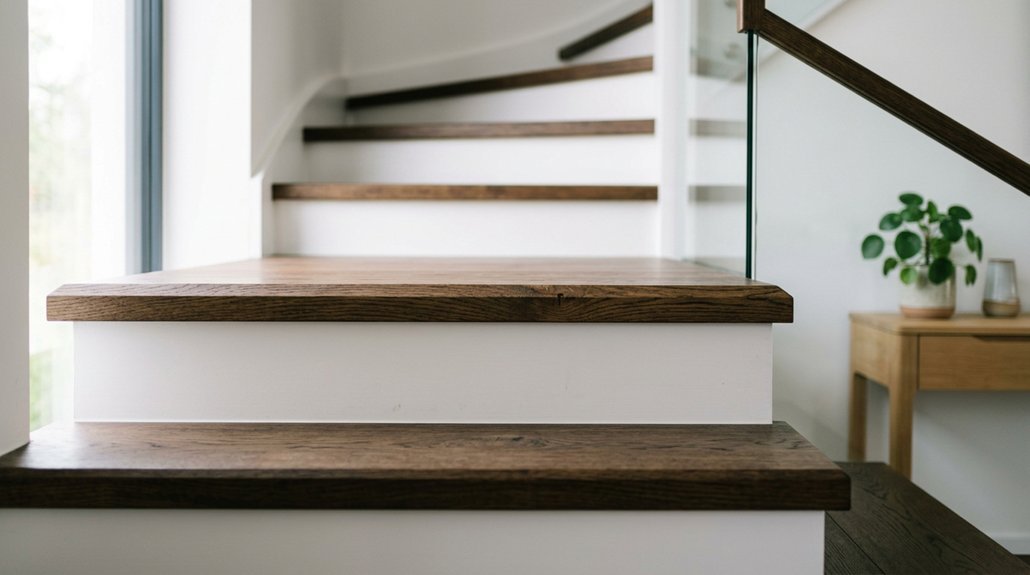


You place your foot on a solid oak surface, feeling the grain beneath your shoe as you ascend to the next level. That horizontal plank, typically measuring 10 to 11.5 inches in depth and 1 to 1.25 inches thick, is your stair tread: the load-bearing component that supports your full weight while the vertical riser hides the structural gap behind it. Whether you’re selecting prefinished White Oak with a 3/4-inch bullnose overhang or unfinished Red Oak requiring on-site staining, you’ll need to match your existing flooring’s thickness, which usually ranges from 3/4 inch to 1 1/16 inch for standard installations. The choice between traditional full-length treads or retro caps that overlay existing steps depends on your staircase’s current condition and your budget, with returns adding 1 to 1.5 inches of finished edge on open sides. Code requirements mandate minimum 10-inch tread depth and maximum 7.75-inch riser height for residential applications, so you’ll want to measure carefully before ordering custom lengths that can exceed 48 inches for grand staircases. Your safety, your home’s value, and your daily comfort all rest on this single decision.
Traditional or Retro Stair Treads: How to Decide
When you’re planning a staircase renovation or new construction, choosing between traditional and retro stair treads requires careful consideration of your existing structure, budget, and aesthetic goals. Traditional treads, measuring 1 x 11-1/2 inches, provide substantial thickness for new builds, while retro treads, sized at 3/4 x 11-1/2 inches with one nose, install directly over existing stairs for efficient remodeling. You’ll find both styles in Red Oak and White Oak, with unfinished and prefinished options across each species. Red Oak unfinished traditional treads start at $24.25 each, making them a cost-effective solid hardwood choice, whereas prefinished Red Oak begins around $38.30 each for added convenience. White Oak prefinished traditional treads command a premium at $60.95 each, reflecting this species’ superior durability and refined grain, with return variants available at $89.45 each for specialized configurations.
Recommended Products

[Heavy-Duty Grip] These rubber stair treads non slip serve as durable stair treads covers, ideal for wood, deck, garage, or concrete stairs. Suitable for use in rain, snow, and heat. Great fit for outdoor and indoor.

Perfect Size for Stairs:At 10 inches wide and 40 feet long, this non slip tape for stairs fits wood stairs, concrete steps, and metal stairs perfectly. Unlike narrow rolls, our 10 inch stair tread tape covers most residential stairs in one strip—no cutting or piecing. Whether you need stair grip tape, step traction tape, or non skid treads for stairs, one roll handles the standard stairs. Ideal for basement stairs, front porch steps, or any staircase that needs serious grip.

EXTRA WIDE COVERAGE - Sized at 10 x 30 inches, these extra wide stair treads provide more surface coverage than standard stair mats. Ideal for wider wooden steps, helping reduce exposed stair edges while creating a more finished staircase appearance and a larger walking area for everyday use.
Stair Tread Returns: Left, Right, and Double Explained
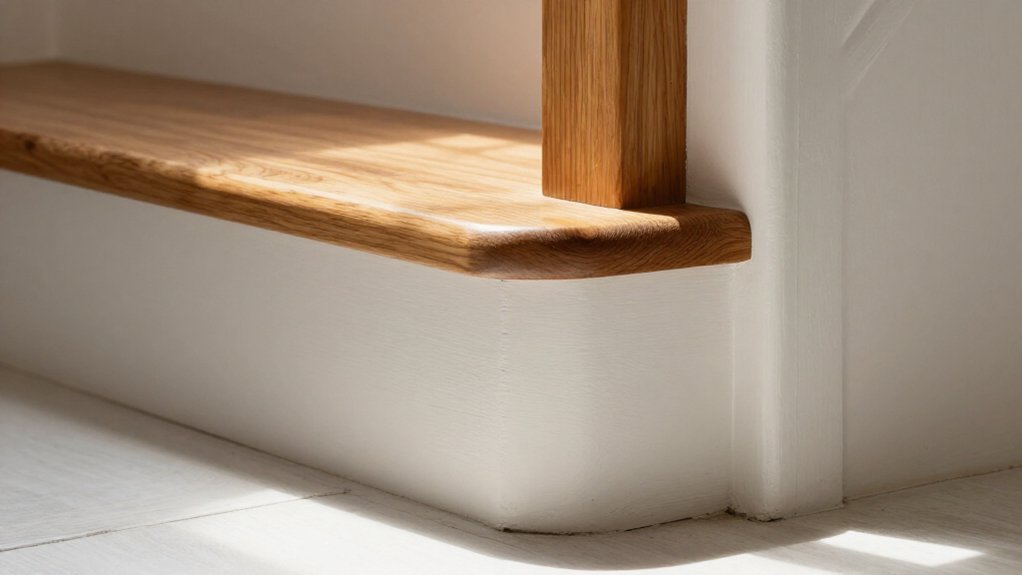
Why does a stair tread overhang matter? You’ll find the answer in the tread return, which is the finished extension of your stair tread beyond the riser that boosts appearance, edge protection, and safety. When you select a straight tread, you’re choosing a single overhang configuration that’s straightforward and cost-effective, though you’ll also encounter double returns that overhang both ends for symmetrical elegance. Your tread return options expand further with curved or mitered styles, delivering seamless transitions and tighter fits against walls or newel posts. You’ll need to match your return choice to stair width, design aesthetics, and handrail termination points. Sometimes you’ll omit the return entirely when architectural preference or installation requirements demand clean, flush edges.
Recommended Products

Easy Installation: Quick peel-and-stick application. Transform your wooden stairs in less than 30 minutes. No nails or staples required, and easy to adjust if misplaced.
Premium Polyester Carpet Treads: Crafted from 100% PureColor Soft Solution Dyed BCF Polyester, these treads feature a classic, soft design to enhance the warmth of your home.
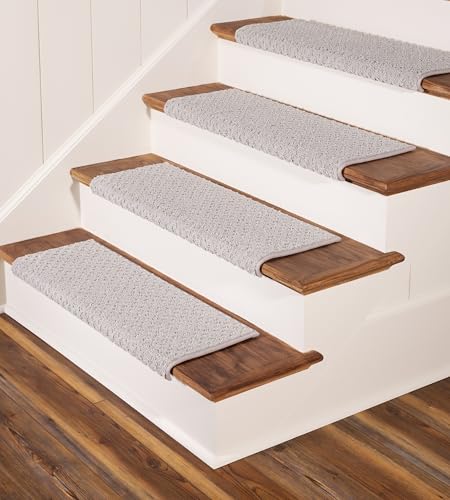
Premium Polyester Carpet Treads: Crafted from 100% PureColor Soft Solution Dyed BCF Polyester, these treads feature a classic, soft design to enhance the warmth of your home.
Red Oak vs. White Oak: Price, Durability, and Finish Options
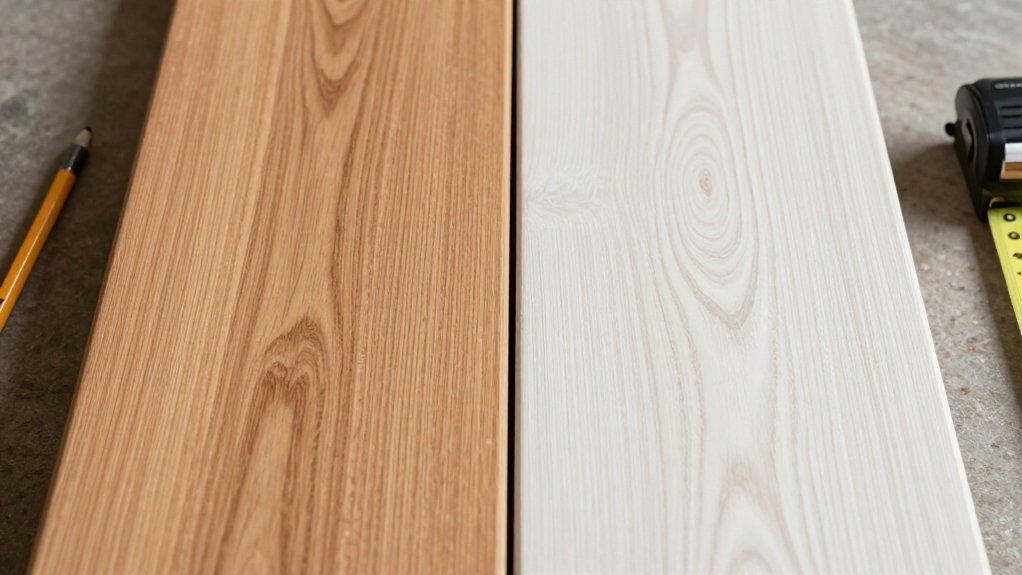
How do you choose between two of the most popular hardwoods for your staircase? You start by comparing price, where Red Oak stair treads offer lower starting points, with unfinished 1 x 11-1/2 options from about $24.25 each, while White Oak commands higher entry costs, with prefinished 1 x 11-1/2 treads from about $60.95 each. You will notice Red Oak emphasizes unfinished and traditional or retro varieties, but White Oak expands your selection with prefinished and UV-coated finishes across both traditional and retro styles. You can find both species in 1 x 11-1/2 dimensions with lengths from 36 to 60 inches, though White Oak consistently positions itself at premium price tiers, with prefinished traditional treads ranging approximately $60.95 to $89.45 versus Red Oak’s $24.25 to $64.02. You should watch for ongoing discounts, as both lines currently feature reduced pricing from listed MSRPs.
Recommended Products

Instant Slip Prevention for the Whole Family - Ensure peace of mind with our non-slip stair treads designed for safety. The high-traction surface prevents accidental slips and falls for active toddlers, elderly family members, and aging pets. The TPU self-adhesive backing grips firmly to wood, tile, marble, and glass without the need for extra tape or nails

Superior Non-Slip Grip: Equipped with a self-adhesive TPE bottom, DailyCuddles stair tread provides excellent traction without extra glue. It safely adheres to smooth surfaces and removes cleanly with no residue, effectively preventing slips and falls

Thick and Comfortable:Crafted from wear-resistant Polyester fibers,the non-slip stair treads offers exceptional durability and a soft feel underfoot with fine stitching and edge-locking technology.The stair carpet treads is designed to withstand daily use without pulling or piling up,ensuring long-lasting comfort and protection for your family.The ideal thickness helps in noise reduction and keeps your feet warm against cold stairs,providing a cozy living environment
Stair Tread Dimensions and Code Requirements
What exactly determines whether your staircase is safe, comfortable, and legally compliant? You must pay close attention to two critical measurements: tread depth, which is the horizontal distance your foot lands on, and riser height, which is the vertical step-up between treads.
Your tread depth must measure at least 10 inches (254 mm), calculated horizontally between the vertical planes of the foremost projection, perpendicular to the tread’s leading edge. Within any single flight, your largest tread depth cannot exceed your smallest by more than 3/8 inch (9.5 mm). Your riser height must not surpass 7 3/4 inches (196 mm), measured vertically between leading edges of adjacent treads. Additionally, your greatest and smallest riser heights within a flight must stay within 3/8 inch (9.5 mm) of each other, ensuring each step feels identical underfoot. These tread depth and riser height rules apply to each flight of stairs or stairway you install, delivering consistent dimensions that protect you and your family.
Recommended Products

Durable Construction: These stair treads are crafted from high-quality materials to withstand heavy foot traffic and daily wear and tear.
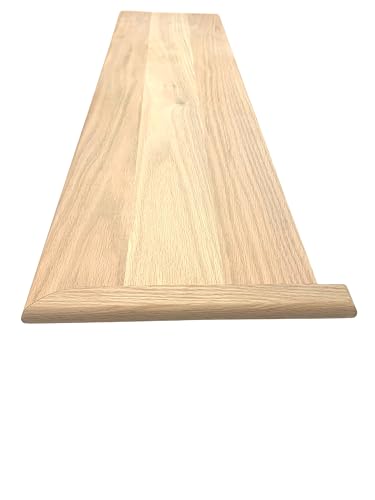
Durable Construction: These stair treads feature a sturdy design with a return for added safety and stability.
Durable Construction: These stair treads are crafted from high-quality materials to withstand heavy foot traffic and daily wear and tear.
Prefinished or Unfinished Stair Treads: Cost and Installation Trade-offs
When you’re weighing prefinished against unfinished stair treads, your decision hinges on a straightforward trade-off between upfront cost and labor investment, with prefinished Red Oak traditional treads, which arrive coated in a UV 100% solids finish and measure 1 x 11-1/2 inches, commanding roughly $38.30 per unit in stock, while their unfinished counterparts, identical in dimension but bare of any protective layer, start near $24.25 each and demand additional finishing work after installation. You save installation time with prefinished stair treads since you skip sanding, staining, and sealing steps, though you pay more per piece. Unfinished options, including Retro styles at approximately $27.93, let you customize color matching but extend your project timeline. White Oak prefinished treads run $60.95 to $89.45, reflecting premium material costs.
Recommended Products
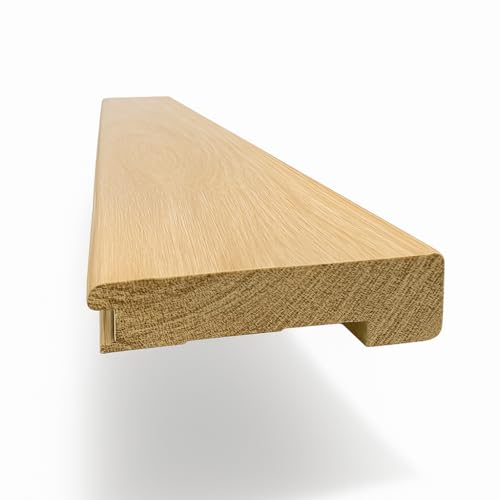
SAVE MONEY BY BUYING ONLY THE LENGTH YOU NEED! EUROPEAN WHITE OAK (UNFINISHED): Solid, kiln-dried stair nose selected to coordinate with most imported prefinished oak floors—ready to sand, stain, and topcoat.
10 PACK OF EUROPEAN WHITE OAK (UNFINISHED): Solid, kiln-dried stair nose selected to coordinate with most imported prefinished oak floors—ready to sand, stain, and topcoat.

Durable Construction: These stair treads are crafted from high-quality materials to withstand heavy foot traffic and daily wear and tear.
