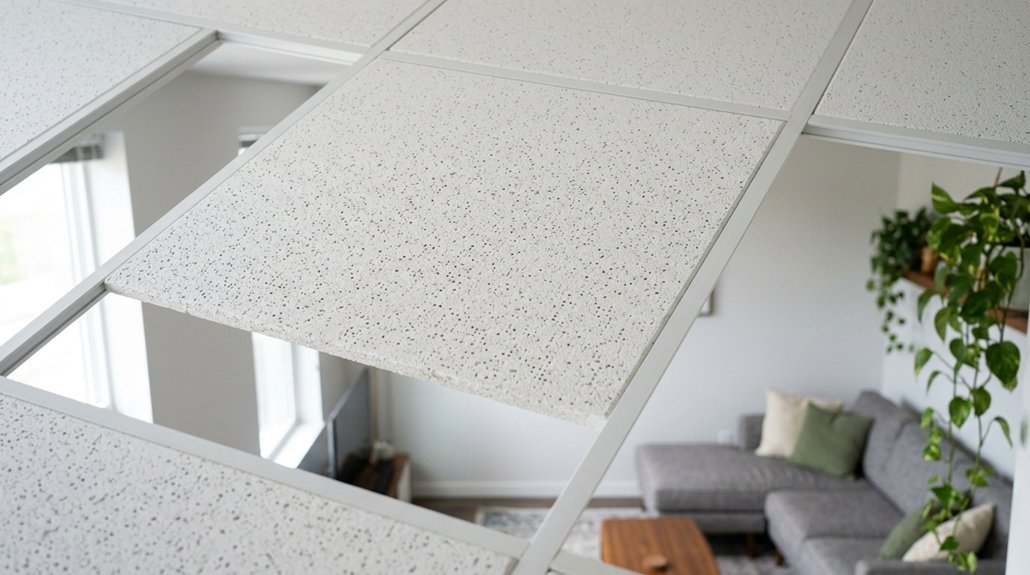
What Are Ceiling Tiles Made Of?

materials used in ceilings tiles

You’ve probably never given a second thought to what’s overhead, yet ceiling tiles shape everything from the air you breathe to how well you hear conversations below. These unassuming panels hide a surprising complexity: mineral fiber blends containing 60-70% recycled content and perlite, fiberglass woven with formaldehyde-free binders, PVC with hollow cores that resist moisture, and even stone wool rated for fire safety up to 2,000°F.

Your choice matters because materials release volatile organic compounds (VOCs), trap humidity, or absorb sound at dramatically different rates. The wrong tile in your basement or office could mean persistent odors, mold risks, or acoustic chaos you cannot easily fix. The real question isn’t whether ceiling tiles matter, but which composition actually serves your specific space without hidden trade-offs you’ll regret later.
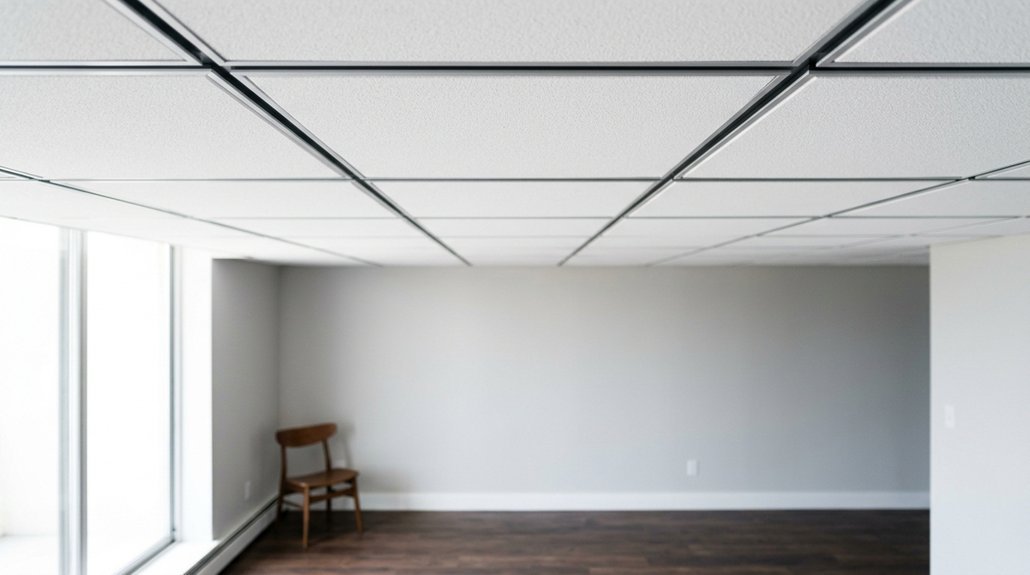
What Is a Drop Ceiling?

false ceiling with suspended panels

When you’re planning a ceiling renovation, you’ll quickly discover that a drop ceiling, also called a suspended ceiling, offers a practical solution you might not have considered: a lightweight metal grid system, typically measuring 2×2 or 2×4 feet with 15/16-inch or slimline 9/16-inch profile widths, hangs 3 to 8 inches below your structural ceiling on hanger wires spaced every 4 feet, creating a hidden plenum space where insulation, electrical wiring, and HVAC ducts can run while removable tiles, manufactured from mineral fiber (which absorbs up to 70% of sound), fiberglass, or PVC, rest securely on cross tees and main runners to provide acoustic control, thermal efficiency with R-values reaching 3.5 per inch, and instant access for maintenance without tools.

You might assume this commercial-grade system belongs only in offices, yet modern residential options, including wood-look laminates and coffered designs, have changed what was once purely functional into something that can compete aesthetically with drywall while solving problems traditional ceilings cannot. The real question isn’t whether drop ceilings work, it’s whether you’re choosing the right grid type, tile material, and installation approach for your specific space, because a 400-square-foot basement project can range from $800 for basic mineral fiber to $3,200 for premium acoustic panels, and that cost difference hinges on decisions you’ll make before purchasing a single component.

hometrendstudio.com
Privacy Overview

This website uses cookies so that we can provide you with the best user experience possible. Cookie information is stored in your browser and performs functions such as recognising you when you return to our website and helping our team to understand which sections of the website you find most interesting and useful.